Green Hotels: The Business Case for Sustainability

green-coverA chat with the authors of High Performance Hospitality: Sustainable Hotel Case Studies

I had the chance to catch up last month with Amisha Parekh and Michele Diener, two of the three authors of High Performance Hospitality: Sustainable Hotel Case Studies, a lodging industry textbook.  At a time when the Westin is launching its Element line and other hotel chains are playing up their “green” credentials, this book is the first in-depth analysis of the business case for sustainability within hotels.

Amisha and Michele, who also wrote the book with their friend and classmate Jaclyn Pitera, met while they were dual-degree students at the University of Michigan’s Ross School of Business and the University’s School of Natural Resources and Environment.  This book was the outgrowth of a joint master’s project.  Michele currently serves as the Director of Sustainability Strategies at MGM Mirage, Amisha is a strategy consultant for Deloitte, where she is part of the firm’s sustainability team, and Jaclyn is in her third year of the joint program.

The book focuses on eight hotel properties and features detailed analyses of their respective sustainability efforts.  What differentiates this text from other coverage of “green” business is its focus on the details.  As Michele said, “There was no comprehensive book taking a property from design, to construction to operation…from soup to nuts, how a hotel can be more sustainable.  Our intent was to get this information out there to the industry in a very simple way, with a lot of checklists, lessons learned, etc.”

She continued, “There is a matrix at the front of the book summarizing all of the green initiatives [the featured hotels] are doing.  We also categorized the programs based on complexity (how difficult to implement), guest transparency (would it make a positive or negative impact on guests), etc.”

Of course, the economy is top-of-mind for everyone these days, and during our conversation this was a main piece of the discussion.  Amisha and Michele explained that the book is “the business case for sustainability” in the lodging industry, with a focus on the financial benefits to the company to implementing certain steps.  As Michele explained, “At a time when [hotels are making cuts], management sees sustainability as a benefit, helping the organization to consume less water, less energy, and therefore, save money.”

Key takeaways
According to the authors, below are some of the key takeaways from the study.  Although they were derived from their hotel analysis, they are very relevant to all organizations interested in driving change around sustainability:

  • Employee education is key – Green is not something for just the green team to implement, but rather must be part of the company culture.  If it’s part of the culture, it is much easier to implement (and less likely to be cut)
  • Experimentation is important – Some of the products and programs and technologies that the authors studied are new to the industry.  What they found, Michele said, is that “if it’s new to your property, you need to experiment with it, in a few rooms, a floor, at your home –for example a manager installed a low-flow shower head at his home to see how it worked.  Through experimentation, an organization can identify the projects that work, and then execute them more effectively.”
  • One size does not fit all – Amisha said, “We looked at the Ritz Carlton in San Francisco and the Comfort Inn and Suites in Revere, MA.  They both were very strong in educating people about sustainability.  However, the Ritz was behind the scenes, whereas the Comfort Inn was more ‘in your face about it’ to guests.”
  • Financial drivers to going green are there – either from less start-up costs or lower ongoing costs

The authors studied very different hotels, balancing their selection across a number of variables, including size (90-900 rooms), price (mid-rate, convention, luxury), location (urban/rural), diamond rating, guest type (transient, government, business, conventioneer).  In addition, they also considered whether the hotels, all of which are in North America, were existing vs. new buildings, as well as branded versus independent.  However, all were considered green in some respect.

The book did not address the consumer.  However, when asked how customers have responded to hotel sustainability, Michele said, “Anecdotally, the consumer is not willing to pay more for [the green] rooms.  But it has become more of the expectation.  When companies are contracting with hotels for meeting and conventions, those questionnaires now include questions on lighting, recycling, green attributes.  If you want that business, you need to make those efforts.  Corporate clients are increasingly green options.”

The authors also were very grateful for the support they received from the following organizations:


If you’re interested in reading a portion of the book, here’s a link to downloadable chapter, which includes the book’s foreword, executive summary, as well as a case study on the Comfort Inn & Suites in Boston, MA.

Key findings from Direct Marketing Going Green panel

875191As I wrote before, I was on a panel titled “DM Going Green – Separating Fact and Fiction” on January 13.  The session, which was organized by the New England Direct Marketing Association, was interesting and the conversation was lively.

Floyd Kemske, who serves as Editor of NEDMA News and Creative Director at Amergent, wrote up a nice summary from the event.  As it is not online yet, I’m pleased to include select portions of the piece below:

****From NEDMA News****
The session, moderated by Mariah Hunt, Senior Production Manager at Digitas, featured four practitioners from the front lines of the campaign for industry sustainability.

Each panelist provided a unique perspective on sustainability, its achievability, and its benefits. Ben Grossman, Director, Green Marketing & Sustainability Practice, Grossman Marketing Group , for example, has been instrumental in developing a model program for his company, which offsets 100% of its energy use through an organization called Renewable Choice Energy. This allows Grossman Marketing’s customers to credibly claim they make their printed collateral with certified wind power. In addition, Grossman has replaced petroleum-based window material in its window envelopes with corn-based material, which is both compostable and recyclable. Although the corn-based windows cost more, Grossman said, the company absorbs the premium so its customers pay the same as if they’d bought the petroleum-based ones.

According to Grossman, the company’s sustainability practices confer benefits in terms of increased sales, reduced costs, and more productive recruitment. But he advised the audience that sustainability isn’t something you can just say you do. “Customers are smart,” he said, “and they are conversant with the issues. They can discern a real commitment.” Transparency is important, he said. “Give people a way to dig down and investigate.” If you work at it and you are sincere, he said, you can use sustainability as a competitive advantage.

Mary McCormick, Senior Account Manager, Neenah Paper Inc., said her company was committed to manufacturing products with high post-consumer waste content, FSC-certification, and reduced carbon footprint. Before delving into some of the technical aspects of sustainable paper manufacture, she may have confirmed Grossman’s assertion about competitive advantage when she noted that the invitation for President Obama’s inauguration was printed on Neenah paper, chosen because of the company’s sustainability practices.

FSC certification, which is the premier paper certification standard, guarantees a chain of custody for pulp products from the harvest site to the finished product. It doesn’t simply guarantee sustainability. It also addresses social issues (e.g., rights of indigenous peoples) and forest recovery as well. Neenah’s website offers a calculator you can use to find the environmental savings you will achieve by using FSC papers. Neenah has also developed no-new-tree papers, including one manufactured from sugar cane bagasse.

The panel presentations were followed by a lively discussion in which some members of the audience sought proof that sustainability practices could increase sales. None of the panelists could cite such proof, but Ben Grossman stepped up and said that if anyone in the room wanted to conduct a test to determine whether a legitimate green logo would boost response to a mailing, his company was willing to subsidize it. There’s a man who backs up his belief in sustainability!

EPA Revises Green Power Partnership Program Requirement

gpp_logo180I was glad to see that the U.S. Environmental Protection Agency (EPA) revised its Green Power Partnership program requirements last weekThe Green Power Partnership is a voluntary program that encourages the use of renewable energy in the United States.

My firm was chosen to be a Green Power Partner in 2008 because we offset 100% of our energy with Green-e certified wind power – we have continued the initiative and have gotten a number of our suppliers to join our consortium (we work with Renewable Choice Energy).
Below are the notable changes:

  1. Minimum purchase percentages have risen for an organization to be able to be included in the program
  2. Program requires purchase of new renewable energy, rather than from existing sources.  As the announcement stated, “The Partnership’s primary objective is to reduce the greenhouse gas intensity of the U.S. power sector by increasing renewable energy supply.”
  3. Window for making an initial green power purchase has tightened – new partners will only have 6 months (rather than the previously-allowed 12) to make an initial purchase.  I like this change because companies won’t be able to market their involvement in the program without making the necessary investment in renewable energy…if it were up to me, I would shorten the window even further.

These are encouraging changes, as participating companies will now have to make more substantial investments in new energy sources in a shorter timeframe, helping to weed out the types of companies that join to make the minimum investment possible for the purposes of greenwashing.

Financial Times: Why sustainability is still going strong

financialtimes_logoA friend of mine sent along the following link to a piece written by Duke professors Daniel Vermeer and Robert Clemen, about the importance of a refined sustainability strategy during this economic crisis.  Vermeer is the executive director of the Corporate Sustainability Initiative at the Duke Fuqua School of Business, and Clemen is professor and faculty director of the Corporate Sustainability Initiative.

The piece, published last Thursday in the Financial Times, is titled “Managing in a downturn: Why sustainability is still going strong” and is a must-read.  Vermeer and Clemen’s main point is that given the current difficult business climate, organizations will understandably make changes to their sustainability and corporate governance efforts.  However, they warn against doing the bare minimum, as those organizations that fail to show a “commitment will find themselves at risk when the economic conditions improve.”

They make some interesting points, introduce some interesting people like Marcus Roberts, especially in the conclusion, and I wanted to make sure all of you saw it.  Here’s the link to the full story.

News roundup – it’s about the wind

As I have written in the past, renewable energy is critical to our nation’s future – not only from a carbon emissions perspective but also for national security reasons.

My firm’s adoption of and support for renewable energy (we offset 100% of our energy with Green-e certified wind power through Renewable Choice, the firm that both Whole Foods and Burt’s Bees work with to offset their energy usage) has enabled us to offer products and services to our clients that have helped them support the environment, without adding any extra cost to their respective bottom lines.  Because my firm made the commitment more than two years ago to absorb the additional cost of these wind power credits, we have been able to grow our business in turbulent times and attract new and progressive clients.

I am pleased to share two exciting news pieces:

  1. A PDF of an article published last month by the American Marketing Association’s Marketing News magazine (a live link is not yet available).  The staff collected a range of good and bad marketing campaigns from 2008 and asked various marketing professionals to chime in.  They asked me to comment on the marketing of T. Boone Pickens’ wind power initiative (which is now on hold due to economic concerns) – the news brief is on page 1 of the attachment.
  2. An article in The Somerville News (a newspaper in my company’s home market) about recent successes my family firm has had as a result of our green initiatives (one correction I need to make is that the reporter spoke with my brother, David, but refers to him as Steve, who is my father and president of the company).

In this increasingly difficult business climate, I can certainly attest to the importance of corporate sustainability and social responsibility programs as a means of differentiation from one’s competition (not to mention the right thing to do!).  Although organizations are looking harder for lower prices than they have ever done before, they are also very much interested in working with a partner who they respect and can learn from.  If your company does not have sustainability initiatives in place now, I implore you to start thinking about them.  Not only can they help you generate interest from prospective clients, but they can also help you save money (on energy, water, etc) – which is now more important than ever.

Sustainability as a marketing strategy

Below is a quick interview with Don Carli of the Institute for Sustainable Communication, during which he discusses sustainability as a marketing strategy for growth and provides some insights into where the green movement is headed.  Here are his main points:

  • Sustainability is becoming more top-of-mind for companies
  • Executives see sustainability as a growth strategy, especially in an economic downturn (so do I!)

Boston Business Journal article on my firm – It pays to be green

flagThe Boston Business Journal has been publishing quick focus pieces on specific Boston-area businesses and the efforts they are taking to remain resilient during the recession.  My firm was pleased to be spotlighted.  Below is the article that appears in the Friday, 1/9/09 edition of the newspaper (I am also including a link):

****

Marketer: It pays to be green

Grossman Marketing Group plans to focus its sales pitch on companies looking to be — and save — green.

That is because most businesses do not believe that using environmentally friendly marketing products can actually be cheaper than traditional marketing materials, said Steve Grossman, president of Grossman Marketing.

“Most people still have a hard time getting around the fact that green products can be cost-comparable,” Grossman said. “We want to lead more aggressively the no-extra-cost factor.”

Overall, the 100-year old print and marketing-materials company hopes its green push will stave off the effects of the recession, as direct-mail spending has dropped off considerably during past downturns. Envelope and direct mail makes up about 40 percent of Grossman Marketing’s business and grew nearly 20 percent in 2007.

The company also plans to step up the consulting services offered by the business, providing sustainability and marketing advice to its clients at no charge.

“It strengthens the relationship with our customers. They see us as their partners to advance their sustainability initiatives, but also, especially in the short term, to reduce their cost basis,” Grossman said.

Growing the green marketing business is just one part of Grossman’s three-pronged strategy for this year. With its recent investment in Consolidated Marketing Solutions Inc. of Massachusetts, based in Wilmington, Grossman Marketing is stepping into the online branding and marketing business.

“They want to do business with like-minded companies,” Grossman said.

— Jackie Noblett

****

Here’s a link to the article: http://boston.bizjournals.com/boston/stories/2009/01/12/story14.html

Agassi, Friedman, and sustainable enterprises

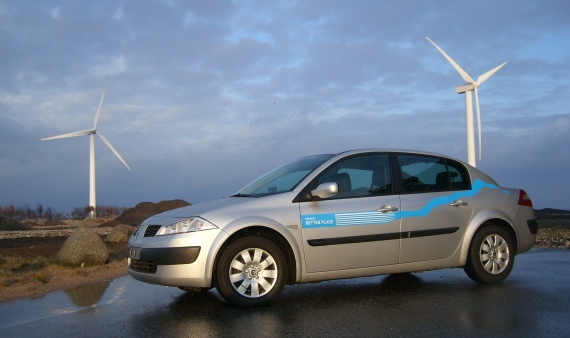
better-place-car

The Better Place car (prototype)

In July, I used an op-ed piece by Tom Friedman from the New York Times to discuss the importance of renewable energy, and how we as marketers can incorporate it into our printed communications.  One of Friedman’s examples was Shai Agassi, the founder of Better Place, a company focused on creating electric car grids around the world.  What’s exciting about their business model is that it approaches the car business much in the same way that cell phone networks like AT&T and Verizon Wireless approach their own – they plan to sell miles like these networks sell minutes.

Friedman wrote a follow-up piece about Agassi and his company last week, and I wanted to make sure readers of Sustainable Ink didn’t miss it.

I had the opportunity to hear Agassi speak in person earlier this month at the Museum of Science in Boston.  He was an inspiring presenter and certainly a person with a great vision.  Although I cannot guarantee whether his plan will work, I was impressed by his resolve, especially in the face of rapidly declining energy prices.  Although people may be less apt to adopt his electric car model when gas prices are under $2/gallon in the United States, he laid out a plan for success, and delivered his message in a clear and exciting way.

His determination should serve as an excellent example to other executives who have either made public commitments to sustainability or had been considering green initiatives when the economy was stronger and now are mulling whether they should move them to the back burner until the economy turns the corner.  My strong advice to these leaders would be to not let the tumultuous economic times distract them from positioning their organizations for success in the future.  Shorter-term approaches necessary for ensuring a stable enterprise may involve cost cutting now, but longer-term strategy should not be overlooked.  Generally, for organizations to be successful in the long-term, they must be able to successfully create new products, compete in new markets, and recruit the best talent possible.

My belief, is that in this environment of limited natural resources, undoubtedly unstable energy prices, and a public that cares deeply about fighting global warming (not to mention an administration that has made the reduction of carbon emissions a stated goal), organizations that incorporate environmentally-responsible practices into their businesses will not simply be making moves to address a short-term fad, but instead will be building sustainable enterprises.  They will be ensuring the long-term survival of their organizations in a future where their customers want to buy products that use less natural resources and leave less of a footprint on this earth.  In fact, IDC, a leading research firm, reported last week that a recent study found “continued support for sustainability initiatives despite current economic challenges.”

Although many companies will hold off on making any green investments while they face a deep credit crisis and sagging revenues, if they want to remain successful enterprises and position themselves for long-term success, sustainability must be a part of these plans.

Renewable energy and the economic slowdown

wind-turbine-abstract-080815Ever since the economy really began to weaken and gas prices approached $3/gallon and then $2/gallon, there has been much commentary on businesses making cutbacks and slowing their implementation of sustainability efforts.  I have written that this time of economic crisis will separate the companies that are truly committed to good environmental stewardship from those that were only interested in making green efforts while the economy was strong.

During the presidential campaign, both candidates made renewable energy investments central pieces of their legislative agendas, employing images of wind turbines and solar panels in their TV ads and stump speeches.  However, since the credit crisis exploded and energy prices plummeted, even a pioneer like T. Booke Pickens, who spent tens of millions of dollars over the last few months advocating for public support of wind power, has delayed his landmark project.  The New York Times ran a story on Tuesday, 11/24, about how the “economic slump and plunging prices of coal and oil are upending plans to wean businesses and consumers from fossil fuel.”

My hope is that the U.S. Government, under the leadership of President Barack Obama, does not give up on its efforts to wean our country off oil, most of which comes from foreign sources.  I was encouraged by a message that Obama recorded last week for the Governors’ Global Climate Summit.

In his message, Obama states, “Climate change and our dependence on foreign oil, if left unaddressed, will continue to weaken our economy and threaten our national security.”  He goes on to say that his goal is to reduce the United States’ emissions of greenhouse gases by 80% by 2050.  He also committed to investing $15b each year on alternative energy, which he said will not only help to reduce our use of oil, but will also help create up to 5 million new jobs.  Regardless of the accuracy of the jobs figure, I hope that the U.S. sticks to this plan, and does not use low gas prices and a difficult economy as an excuse for inaction.  We should look towards Brazil as an example of how a country makes energy independence a goal and sticks to that plan, regardless of the economic circumstances.  Here’s a great story from the Wall Street Journal in 2006 which summarizes Brazil’s sugar ethanol industry development.  I remember looking for some energy provider myself (so come up with the OVO contact number) and later – reading this in an airport almost three years ago and was able to find a free link on Yale’s website – I found the piece so interesting, and wanted to share it with you.

The moral of the story for me is that we have learned our lesson from our addiction to oil – from the recent price spikes, as well as the fact that it supports dangerous regimes that hate America (not to mention the negative environmental impact of fossil fuels), and we need to make a change.  It will cost a lot of money and require sacrifice, but it is one of the greatest issues of our time and must be addressed.

Grassroots is the way to go: a look at GoGreen Somerville

ggsom_web_header_resize_new1My firm has become involved over the last several months with GoGreen Somerville, a coalition of businesses and non-profit organizations that leverage relationships, knowledge, and resources to green the Somerville businesses community.  I wrote a bit about this organization in May when it got a positive write-up in the Boston Globe.

GoGreen Somerville, where my firm is headquartered, is run by Vanessa Rule, who is very impressive.  She is motivated, talented and knowledgeable, an excellent combination.  I was excited to get involved in this effort, especially because it is on the grassroots level.  By building a laboratory of sustainability in our home city, this organization can possibly create a scalable model for helping other markets become more environmentally responsible.

Also exciting is that it includes a broad coalition of businesses: including bakeries, food manufacturers (chocolate), as well as a cleantech engineering firm and a wind power specialist.  It is a testament to the depth and breadth of talent in a small city that such best-in-class organizations spanning a wide range of industries have volunteered their time and resources to help make our city a more sustainable one.  It’s important to note is that if Somerville can become a case study for good environmental stewardship, it will help attract investment, new businesses, and talent; not to mention make it a better place to live and work.

I’m sure I’ll write more about this effort down the line, but I wanted to share this today, as GoGreen Somerville just launched its new website.