Recent award for green marketing leadership

nedmaLogoI was honored and humbled to receive the 2009 New England Direct Marketing Association Prodigy Award, for my work in the green marketing and sustainability space.  I received the award at the NEDMA 2009 Annual Conference held earlier this month at Bentley College in Waltham, Massachusetts.


According to NEDMA, the Prodigy Award is given each year to one marketing professional in New England under the age of 30 who has added the most to the art and science of direct marketing in the prior year.  NEDMA started the award eight years ago to recognize some of the most talented young marketers in the region.  During that time, members of organizations like Hill Holliday, Mullen, Oceanos and Vistaprint have been recognized for their expertise in areas including graphic design, direct mail and interactive media.

Many thanks to NEDMA for including me in this process and for all the work the organization does  to help develop the next generation of marketing professionals in New England.

Please click here to read the full press release.

The critical importance of transparency as part of sustainable communications – Ad Age

Transparency-720358As most of those who read Sustainable Ink regularly know, I’ve been an advocate for transparency in everything individuals and companies do.  I’m pleased to share an article that Diana Verde Nieto (CEO of Clownfish, a sustainability and communications consultancy based in the U.K.) wrote for Advertising Age, titled: The Four C’s of Survival: How Sustainable Communications Can Help You Get Through the Recession.

I’m glad to see that Diana shares and is promoting some of the values and principles that I have always believed are essential ingredients of a credible, robust sustainability program, and I hope you enjoy the article.

Here’s a downloadable version of the article.

Best wishes for a happy and healthy Memorial Day Holiday.

It all adds up…

****Guest post from David Grossman (Ben’s brother, and SVP, Grossman Marketing Group)****

While driving back to my office from a meeting, I saw the following sign posted on the back of a Staples delivery truck.   On the back of the truck, there is a small box that states, “Top speed set at 60.  It saves fuel & reduces emissions.”

We brake for the environment: the back of a Staples delivery truck.  Photo taken May 20, 2009 by David Grossman.

We brake for the environment: the back of a Staples delivery truck. Photo taken May 20, 2009 by David Grossman.

I want to commend Staples not only for putting measures in place that will help the environment, but for being transparent in communicating their efforts to the general public.  By doing so, they are both helping their business and raising awareness in general of the importance of being green.  So, thank you Staples!

Preview: BrightTALK Green Marketing Summit

brighttalk_logo_blackgreen_medI was flattered to be invited to present to the BrightTALK Green Marketing Summit tomorrow (Friday, 4/24).  BrightTALK is aiming to become the “YouTube for Business,” meaning they arrange targeted meetings/summits online and then store the webcasts so people can watch them in the future (upon registration).

According to the BrightTALK site, “This summit will help companies leverage the growing interest of consumers in purchasing products and services from companies with strong ‘green’ messages through understanding the need to develop a green marketing strategy. Summit attendees will gain insight from companies who have implemented successful green marketing initiatives and improve their understanding of why going green will help build a strong brand connection with their target audience.”

The summit will include representatives from companies like Intel and HP, as well as green marketing experts like Joel Makower, who runs GreenBiz, among other ventures.

My session, scheduled for 4 pm EST, is titled: Green Marketing: Bridging Theory & Practice – A Guide to Making Your Direct Marketing Efforts More Sustainable. To attend the summit, please click here.

Here’s a brief abstract on my talk from the BrightTALK site: “Please join Ben Grossman, Director of Grossman Marketing Group’s Green Marketing & Sustainability Practice, to learn about the latest trends in green marketing.  Specifically, Ben will discuss how the green movement is having an impact on communications, and will highlight ways to make your organization’s direct marketing efforts more sustainable and relevant to your constituents.  He will highlight creative ways that he and his colleagues have helped organizations like ZipCar, J.P. Morgan and the National Park Foundation, leverage green marketing techniques without adding any extra cost to the bottom line.”

There will be a live Q&A session, so I will be back with a full report over the next several days.

Grossman Marketing wins green business award from Boston Business Journal

The Green Business Summit will be held on Friday, May 15, 2009.

The Green Business Summit will be held on Friday, May 15, 2009.

We at Grossman Marketing Group were honored and humbled this afternoon to learn that we are one of this year’s recipients of a Boston Business Journal green business award.  The award will be presented at this year’s Green Business Summit, scheduled for Friday, May 15, at 7 am at the Sheraton Boston Hotel.

We were included in the “Innovation” category, and recognized for our work in the green marketing and sustainability space.  We are especially grateful to our client, Zipcar, for nominating us for the award.

Below please find the full list of winners:

Invention:

Workplace:

Innovation:

Design:

Here’s a link to learn more about the event program as well as to register.

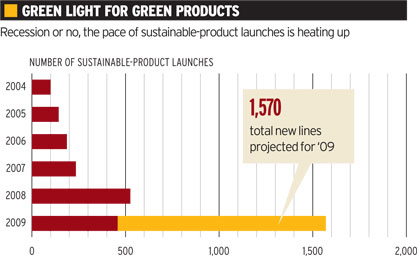
Ad Age: Green-Marketing Revolution Defies Economic Downturn

Source: Datamonitor's Product Launch Analytics

Source: Datamonitor's Product Launch Analytics

This week’s Advertising Age features a very interesting and timely (Earth Day is this week) article, titled “Green-Marketing Revolution Defies Economic Downturn.” The writer, Jack Neff, starts off the article with the following statement: “Green marketing is turning out to be surprisingly recession-proof.”

Neff points to product launch and sales data that indicate that even during the recession, consumer-packaged goods manufacturers are seeing significant revenue growth for their green offerings.  In fact, according to Seventh Generation CEO Jeffrey Hollender, his company’s sales were up 50% last year and 20% in March 2009 versus March 2008.

The article continues that as opposed to previous recessions, during which sales of green products “had the air taken out of them,” sales of green products have remained stable (and are still growing) in the current downturn.

Neff includes some interesting tips for green marketers at the end of the article, and I would certainly recommend giving it a quick read.

Here’s a link to the full article.

WSJ: Interesting report on eco-logos and green marketing

Courtesy Wall Street Journal.  Illustration by Michael Witte.

Courtesy Wall Street Journal. Illustration by Michael Witte.

The Wall Street Journal has an interesting report in Thursday’s issue titled: “As Eco-Seals Proliferate, So Do Doubts.” The article discusses how a number of unregulated organizations that purport to verify “green” product claims have sprouted up, which only makes buying these products even more confusing for businesses and consumers.

Here are the two main points that the writer makes:

1) The U.S. Government may need to oversee the creation of Federal green marketing standards, similar to what the U.S. Department of Agriculture has done with organic foods.

2) Eco-seals that are verified by reputable third-party organizations are more reliable.  One example the writer provides is a Canadian-based organization, Ecologo.

I couldn’t agree more.  I have been pushing my industry and my clients to be transparent about green marketing claims, especially because consumers are smart and see through “fuzzy” and unsubstantiated claims that organizations make.  This is why when a client uses eco-friendly papers in their marketing programs and wants to explain the environmental benefits derived from these choices, they should not use a paper company’s calculator to arrive at these statistics.  Rather, they should use the paper calculator created by Environmental Defense, a leading non-profit dedicated to the environment.  I have written about this resource a number of times over the past several years.

I also believe that the Federal government should step in and begin to regulate green product claims.  I know this will be a difficult process, as it would be impossible to apply the same standards across all industries.  Nevertheless, it is important to start now, as it will help companies and individual consumers to better navigate the increasingly-complicated product landscape.

Here’s a link to the full article.

Snapshot: Environmental League of Massachusetts Corporate Council meeting with Governor Patrick

elm_with_wordingAs a member of the Environmental League of Massachusetts Corporate Council, I had the privilege of participating in a private meeting with Governor Patrick and his environmental team last Friday to discuss a wide range of issues.

I was struck by the willingness, openness and accessibility of the Governor and his Secretary of Energy and Environmental Affairs, Ian Bowles, to new, fresh and bold ideas, and their commitment to making Massachusetts a state in which there will be incentives, rewards and opportunities for companies and organizations to do the right thing from an environmental standpoint.

I was especially encouraged, despite the tough economic times, by the Governor’s commitment to make the necessary investments to enable Massachusetts to become a national and international “green” hub for sustainability, cleantech and other environmental innovations.

Here’s a list of the other members of the corporate council (in addition to Grossman Marketing Group):

To read more about the council:

  1. Please see the December 2008 Boston Globe article
  2. Please see the council’s member page on the ELM site

Trendwatching.com’s 12 eco-trends to watch

Hey all – I wanted to share this interesting briefing on Trendwatching.com about eco trends that present exciting opportunities for marketers and entrepreneurs.

Trendwatching refers to these opportunities as an eco-bounty, and they provide the following definition: “ECO-BOUNTY refers to the numerous opportunities, both short and long term, for brands that participate in the epic quest for a sustainable society. Some of these opportunities exist despite the current recession, others are fueled by it, not in the least because of new rules and regulations. Downturn-obsessed brands who lose their eco-focus will find themselves left out in the cold when the global economy starts recovering.”

Have a great weekend!

Green Hotels: The Business Case for Sustainability

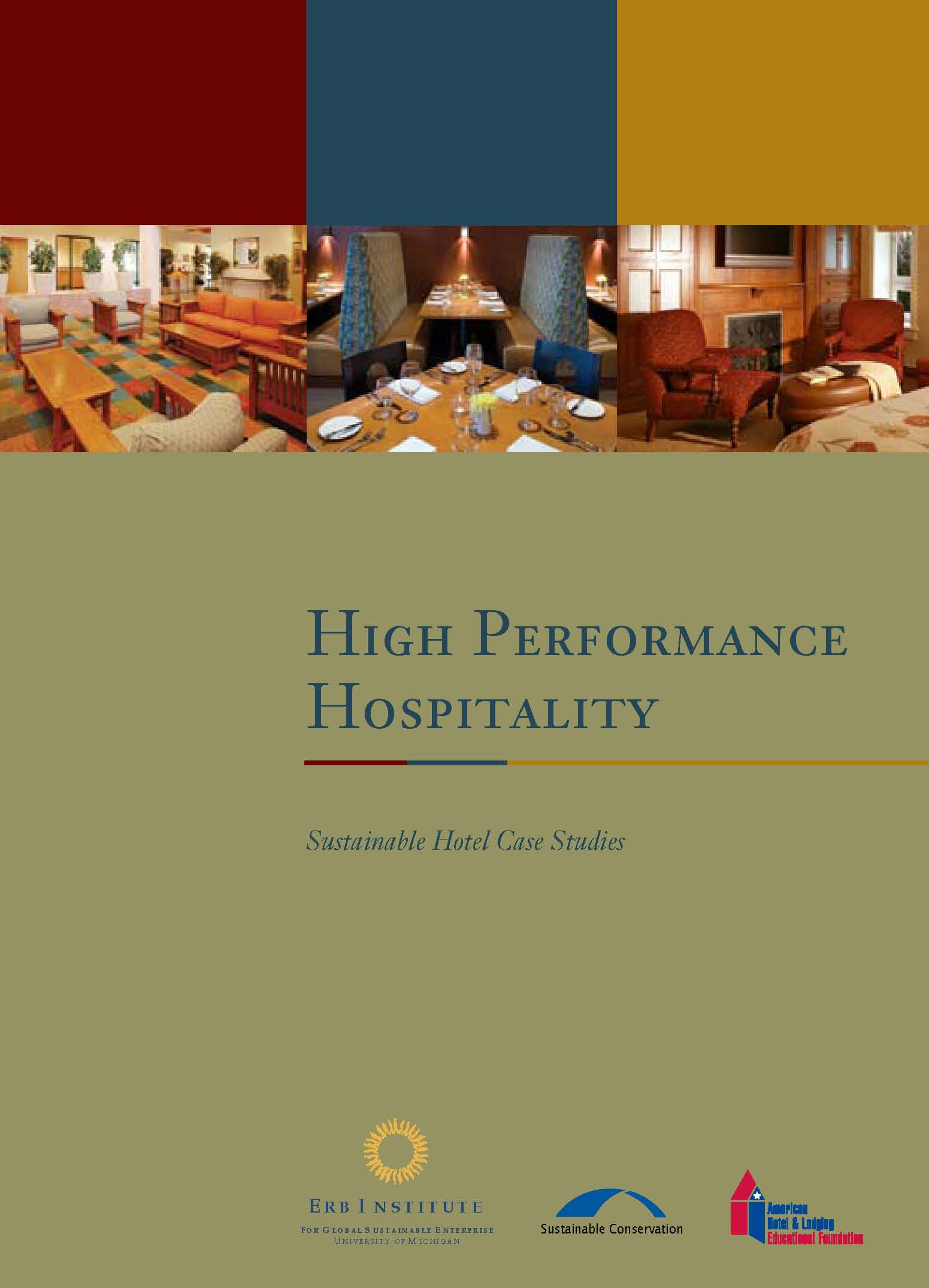
green-coverA chat with the authors of High Performance Hospitality: Sustainable Hotel Case Studies

I had the chance to catch up last month with Amisha Parekh and Michele Diener, two of the three authors of High Performance Hospitality: Sustainable Hotel Case Studies, a lodging industry textbook.  At a time when the Westin is launching its Element line and other hotel chains are playing up their “green” credentials, this book is the first in-depth analysis of the business case for sustainability within hotels.

Amisha and Michele, who also wrote the book with their friend and classmate Jaclyn Pitera, met while they were dual-degree students at the University of Michigan’s Ross School of Business and the University’s School of Natural Resources and Environment.  This book was the outgrowth of a joint master’s project.  Michele currently serves as the Director of Sustainability Strategies at MGM Mirage, Amisha is a strategy consultant for Deloitte, where she is part of the firm’s sustainability team, and Jaclyn is in her third year of the joint program.

The book focuses on eight hotel properties and features detailed analyses of their respective sustainability efforts.  What differentiates this text from other coverage of “green” business is its focus on the details.  As Michele said, “There was no comprehensive book taking a property from design, to construction to operation…from soup to nuts, how a hotel can be more sustainable.  Our intent was to get this information out there to the industry in a very simple way, with a lot of checklists, lessons learned, etc.”

She continued, “There is a matrix at the front of the book summarizing all of the green initiatives [the featured hotels] are doing.  We also categorized the programs based on complexity (how difficult to implement), guest transparency (would it make a positive or negative impact on guests), etc.”

Of course, the economy is top-of-mind for everyone these days, and during our conversation this was a main piece of the discussion.  Amisha and Michele explained that the book is “the business case for sustainability” in the lodging industry, with a focus on the financial benefits to the company to implementing certain steps.  As Michele explained, “At a time when [hotels are making cuts], management sees sustainability as a benefit, helping the organization to consume less water, less energy, and therefore, save money.”

Key takeaways
According to the authors, below are some of the key takeaways from the study.  Although they were derived from their hotel analysis, they are very relevant to all organizations interested in driving change around sustainability:

  • Employee education is key – Green is not something for just the green team to implement, but rather must be part of the company culture.  If it’s part of the culture, it is much easier to implement (and less likely to be cut)
  • Experimentation is important – Some of the products and programs and technologies that the authors studied are new to the industry.  What they found, Michele said, is that “if it’s new to your property, you need to experiment with it, in a few rooms, a floor, at your home –for example a manager installed a low-flow shower head at his home to see how it worked.  Through experimentation, an organization can identify the projects that work, and then execute them more effectively.”
  • One size does not fit all – Amisha said, “We looked at the Ritz Carlton in San Francisco and the Comfort Inn and Suites in Revere, MA.  They both were very strong in educating people about sustainability.  However, the Ritz was behind the scenes, whereas the Comfort Inn was more ‘in your face about it’ to guests.”
  • Financial drivers to going green are there – either from less start-up costs or lower ongoing costs

The authors studied very different hotels, balancing their selection across a number of variables, including size (90-900 rooms), price (mid-rate, convention, luxury), location (urban/rural), diamond rating, guest type (transient, government, business, conventioneer).  In addition, they also considered whether the hotels, all of which are in North America, were existing vs. new buildings, as well as branded versus independent.  However, all were considered green in some respect.

The book did not address the consumer.  However, when asked how customers have responded to hotel sustainability, Michele said, “Anecdotally, the consumer is not willing to pay more for [the green] rooms.  But it has become more of the expectation.  When companies are contracting with hotels for meeting and conventions, those questionnaires now include questions on lighting, recycling, green attributes.  If you want that business, you need to make those efforts.  Corporate clients are increasingly green options.”

The authors also were very grateful for the support they received from the following organizations:

If you’re interested in reading a portion of the book, here’s a link to downloadable chapter, which includes the book’s foreword, executive summary, as well as a case study on the Comfort Inn & Suites in Boston, MA.