Tips from Deloitte: Top 10 list to green your client site

picture21A friend at Deloitte has made me aware of his firm’s “Greening the Dot” program, aimed at helping create awareness among Deloitte’s large employee base that being environmentally-friendly is an important thing to do.  The leaders of this effort frequently send out newsletters with tips to go green and initiatives that the firm is designing to be a more sustainable enterprise.

Not only is this effort a smart play from an employee retention perspective (given the economy, this will be important longer term rather than immediately) but also because it helps Deloitte send a values-laden message to its clients.  As a former consultant myself, I know that this industry is often seen from the outside as tough and unfriendly, and focused purely on numbers and deliverables.  However, I believe that Deloitte’s “Greening the Dot” program helps send a positive message to the outside world.  In the hypercompetitive world of strategy consulting, this can only help.

Below is a “Top 10 list to green your client site” that Deloitte released this week.  Clearly from its title, this is a series of ways that Deloitte employees can help the environment, and do so in very visible ways to the outside world:

  1. Unplug. Unplug “orphan” chargers and power cords which still consume energy when they are plugged in. Nearly 75% of all electricity used to power electronics is consumed by products that are switched off.
  2. Print less. Just because you’re at the client doesn’t mean you can’t reduce the amount you print! Consider having “paperless” meetings. With overhead projectors, we can eliminate the need for paper during meetings.
  3. Print duplex. To reduce your paper consumption, “duplexing“ can be done on copiers and printers.
  4. Use a reusable cup. Use a reusable cup or mug & save those paper or styrofoam cups from going in the trash.
  5. Recycle. Recycle paper, plastic, aluminum, glass, cardboard, and electronics in your local office.
  6. Turn off the lights. Be sure to turn overhead and task lights off as you leave offices and conference rooms. Also, avoid the need for unnecessary lighting by taking advantage of natural light whenever possible.
  7. Power down. Update your power management settings on your laptop to “stand by” or “sleep” after periods of inactivity when plugged in. If you only keep your computer on while you are actually using it, and put it on “stand by” for the rest of the time, you can cut energy use by 55%.
  8. Dress appropriately. Heating and air conditioning are typically the largest sources of energy use in the office. Dressing in layers can help your body adjust to temperature changes in the office. Keep a spare sweater in the office rather than turning up the thermostat or using a space heater.
  9. Travel less. Consider videoconferencing and other technology options to reduce your travel.
  10. Travel green. When traveling, be as environmentally friendly as possible. Bring a reusable mug, carpool and rent the most fuel efficient vehicles, reuse towels and linens, turn off the heating or air conditioning, and turn off all the lights before you leave your hotel room

The newsletter concluded with the following statement: “These small changes will make a big impact. Thank you for taking part in the efforts to make our office a little greener!”

This actionable series of tips, although just a start, provides a simple roadmap to Deloitte consultants of ways to easily go green when on the road at a client site.  None of these tips are difficult to implement, but all are sensible and can have an impact.

Can Green Business Survive the Meltdown?

Despite the recessionary environment in which we live, companies and organizations shouldn’t lose sight of the importance of good environmental stewardship.  My belief is that the truly committed will clearly be separated from the ones who were only interested in making green efforts while the economy was strong.  More importantly, the choices these firms make now while the economy is down will have ramifications for years to come, not only on the environment, but also on their own corporate reputations and future profitability.

I came across an interesting article that touches upon similar points on Harvard Business Online, written by Andrew L. Shapiro, CEO of GreenOrder, and his colleague, David Gottesman.

Here’s a link to the full story.

I will be exploring this issue in greater detail over the months to come, as the broader economy continues to digest the financial crisis, and more data becomes available.

A spotlight on green design

A friend of mine, Scott Belsky, runs a great company called Behance, which designs products and services for the creative community.  One of their products is the Behance Network, which is a social network for creative professionals.  It’s a great place where people share their work, look for gigs, and search for talent.

Last week, they posted an article on green design and the members of the Network that are leading the charge in their various industries to make products that are more sustainable.  As the article states, “The goals of sustainable design are to avoid using non-renewable resources, lessen our environmental footprint, and bring people closer to the environment in which they live. Many designers are heading down the ‘greener path to design’ including architects and interior, industrial, graphic, fashion and urban designers.”

Some of the designers have made sustainable packaging for new CDs, and others have made solar-powered buckets that when left outside in the sun can become a source of light at night (see image above).

What’s important is that product designers are out there, looking to come up with interesting ideas for new items that can help us live more sustainable lives and leave less of a footprint on this planet, while still being aesthetically pleasing.  My research has shown that although people want to buy “green” products, they don’t want to have to sacrifice quality in order to do so.  They are willing to pay more for them as well.  Savvy green marketers will hire people like the ones featured on this network to help them come up with new products to help them send a values-laden message to their customers and generate higher profits at the same time.

Please click here to read the full article.

Newsweek: Green really means business

I had the chance to read an excellent essay in the 9/22/08 issue of Newsweek, by Zachary Karabell of RiverTwice Research, which I strongly recommend.  The main message of the article is that in an era of high energy costs, a company that has sustainable business practices will likely be able to save money and reap positive financial returns as a result.

Karabell writes that “sharply higher prices for oil and raw materials” have made “reductions in energy use economically viable and strategically important in a way that no amount of green activism ever could.”  He continues by discussing Wal-Mart’s efforts to “green” its supply chain: “To maintain its razor-thin margins at a time of record oil prices, which are raising the cost of importing goods from China, Wal-Mart has radically altered how its products are made and how they’re transported. One example: making detergent more concentrated, which leads Wal-Mart suppliers to use smaller plastic containers, which in turn use less petroleum to manufacture those containers, which can then be shipped with more containers in each carton, which leads to less cardboard, which makes it possible to transport more units on each ship or truck, which then reduces the amount of gas used to get those units from the factory to Wal-Mart outlets. The result: Wal-Mart maintains margins and reduces its resource consumption as well as that of its suppliers.”

Karabell also goes on to mention other profit-driven reasons for companies’ sustainability efforts: international regulatory rules as well as studies showing that companies that receive high environmental marks have shown above-average return on investment and stock price performance.

I have frequently written about the importance of green business practices, not only because they are the right thing to do but also because they help the bottom line.
Whatever the reason, the fact that companies like Wal-Mart, Du Pont and Google, to name a few, are all investing heavily in making their businesses less resource intensive, and therefore more profitable, is a great step.  Our national government has not done enough to create incentives for companies and individuals to invest now to save resources and money in the long run, so it is incumbent on the business community to take the initiative.

Relative to my business, Grossman Marketing Group, we strongly urge our clients to not only operate their core businesses responsibly, but also to make the effort to bring that message of sustainability to their constituents through their marketing and communications campaigns.  Whether it’s a piece of direct mail or a giveaway at a tradeshow, by leveraging environmentally-friendly materials, and clearly communicating what they have done to make their pieces less resource-intensive and the savings derived by doing so, they will send a values-laden message to their core customers and donors that will help reinforce their brand and build relationships for the long term.

Here’s a link to the full Newsweek article.

Best practices in green printing: quantifying the benefits of going green – part 2

I frequently encourage clients as well as readers of my blog to be transparent about the environmental savings derived from “going green” with their marketing and communications.

My firm works with the Massachusetts League of Environmental Voters (MLEV), whose mission is to advocate for sound environmental policies and to elect pro-environmental candidates who will adopt and implement such policies.   They are the state affiliate of the League of Conservation Voters.

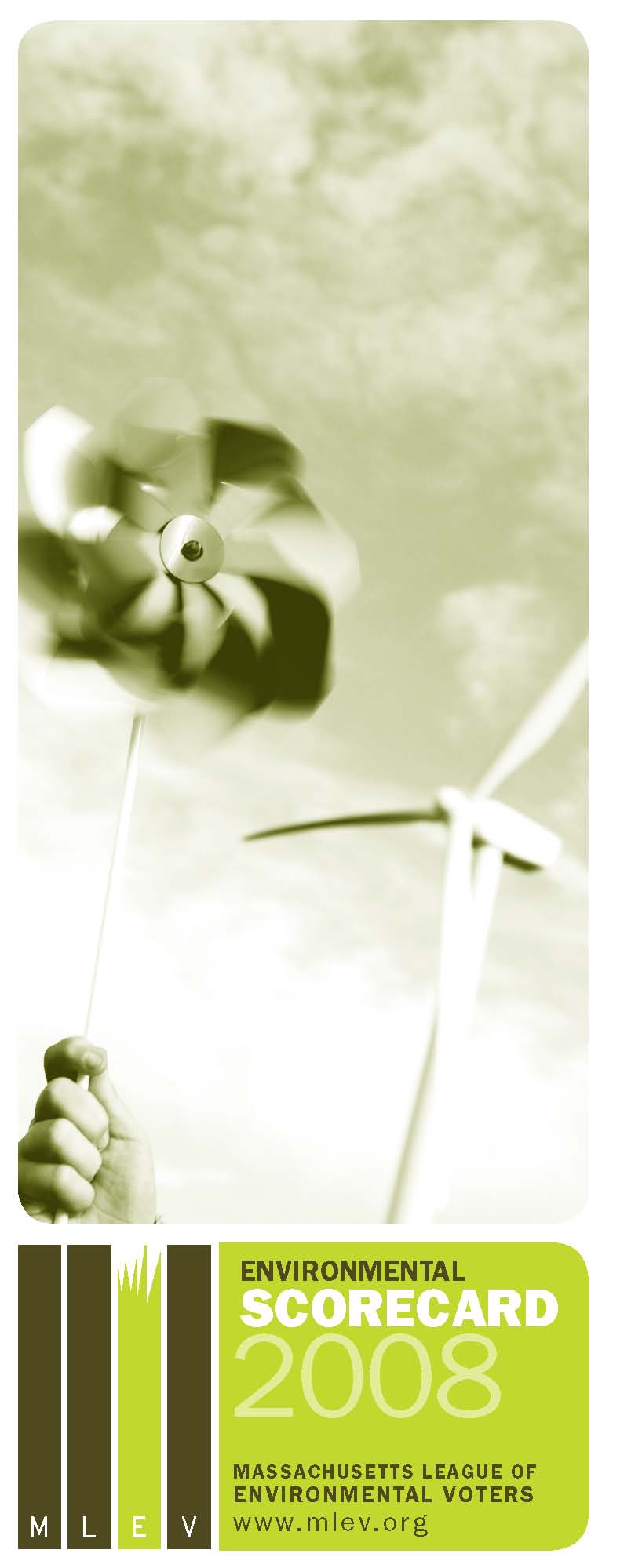
MLEV publishes an annual Environmental Scorecard, which serves as a guide to how Massachusetts legislators voted on key environmental issues during the past legislative session (2007-2008).  On page 2 of the attached PDF, MLEV quantifies the environmental savings from having produced their piece using responsible materials, based on calculations from the Environmental Defense Paper Calculator.

In addition, MLEV included several clean and recgonizable eco-logos on the back of the scorecard, underneath their return address on the mail panel.

These two transparent approaches (specific savings calculated and described inside as well as easy-to-understand labels on the outside) serve as a best practice for anyone in the marketing communications space.

Please click here to view a PDF of the scorecard.

Alternative energy: striking a balance between caution and execution

There has been increasing news coverage of alternative energy, most notably due to the explosion in energy prices over the last couple years.  I saw two interesting articles over the last day, one from the conservative editorial pages of The Wall Street Journal, and the other from The New York Times.

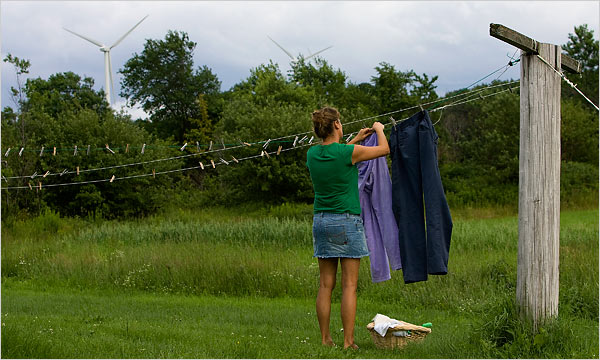
Please note – photo courtesy of The New York Times (photographer: Christinne Muschi).

The WSJ opinion piece points out that one of the key barriers to growth in alternative energy is infrastructure, most notably transmission lines connecting the sources of energy (wind and solar fields in rural and desert locations in the plains and Southwest) and the cities in which most people live.  The WSJ, in it’s characteristic fashion, blames this challenge on liberals, who they claim support alternative energy but oppose the construction of transmission lines, as they often have to go through protected lands.  Here’s a link to the piece.

The Times describes challenges and conflicts of interest that have arisen in upstate New York, where wind revenue has become critical for family farmers.  The article highlights instances when local town boards have voted on wind leases for firms when several of the individual members already had contracts in place for their own farms.  A key issue, the article goes on to discuss, is that there is no statewide (New York) law on wind power, so it is up to the individual towns to decide.  Here’s a link to the article.

If alternative energy is to become more widespread (according to the WSJ, wind only provides two-thirds of 1% of electricity generated in the U.S., and solar one-tenth of 1%), there will have to be better statewide and national legislation that fast tracks the development of wind farms, solar fields, and other energy sources.  At the same time, a balance has to be struck between speed and careful examination of the intricacies of development (impact on local environments, costs, etc).

Nevertheless, it is no longer debatable that these technologies are needed.  In fact, weaning our country off of foreign oil and developing better domestic, renewable (and clean) energy resources are key elements and ingredients to the future success of our country.  My sincere hope is that the right balance can happen in order to unlock this power and bring jobs to local markets with it.

Sustainability becomes differentiator for colleges

I read a very interesting article in the Boston Globe last week, which discussed the rising tide of “green” initiatives at colleges and universities across the country.

The article, titled “Not to be out-greened: Colleges grow more Earth-conscious to lure students,” focused on the increasing importance of universities’ environmental stewardship programs to college students, and how they can have an impact on their application decisions.  According to the article, Julian Dautremont-Smith, the associate director of the Association for the Advancement of Sustainability in Higher Education, said, “The current generation of students wants to go to schools that take their environmental responsibility seriously.”

Campus green initiatives have become so mainstream that even The Princeton Review has started rating schools on their respective commitments to the environment.  For more coverage on the Princeton Review survey and commentary on the explosion of green campus initiatives at colleges, please see an article from the most recent Education Life section in the New York Times.

The Education Life section (published Sunday, July 27) had several other articles on green topics that may be of interest to you.  Here’s a link to the section itself.

A key takeaway I had when reading these articles was that even if a school has a sterling commitment to the environment, if it does not clearly communicate its good work to the community it large, the impact on its applications, donations and goodwill generated will be muted.  Therefore, it is critical that schools get the message out to their constituents (through their websites, social networks, and printed marketing materials, among other channels) that they are firmly committed to sustainability.  Whether the printed versions of these materials are made with wind power or printed on post-consumer recycled paper, it is important that these green initiatives are translated onto the printed page.

For more on green printing recommendations, please see a post I wrote earlier this year.

Exciting offer for Sustainable Ink readers

Hi all – my last post on Tom Friedman’s op-ed, and the traffic and links from all of you, got noticed by his publisher, Macmillan.

They contacted me yesterday with an offer for readers of Sustainable Ink.  From now until August 11th, they are giving away the audiobook version of his bestseller, The World is Flat, online in anticipation of his new book Hot, Flat, and Crowded: Why We Need a Green Revolution — And How It Can Renew America. You will also receive an exclusive audio excerpt of his new book well before its September publication.

Here’s a link to the offer: http://www.thomaslfriedman.com/giveaway

As someone who’s read The World is Flat, I definitely recommend it, and this is a way to get it for free.

Have a great weekend!

“Texas to Tel Aviv”: Excellent op-ed piece by Tom Friedman in the NYTimes

I had the chance to read Tom Friedman’s most recent op-ed piece, “Texas To Tel Aviv” in the New York Times today, and felt compelled to share it with the folks who read Sustainable Ink.

The article focuses on two people: T. Boone Pickens and Shai Agassi.  Pickens, who made his fortune in the oil business, is leading a charge to get the United States to devote a significant amount of resources to the development of wind energy.  In fact, he has spent $2 billion of his own money buying land in the Texas Panhandle as well as 700 wind turbines from GE (their largest turbine order ever), in order to create the largest wind farm in the world.  To read more about his efforts, please visit the Pickens Plan website.

Agassi, an Israeli technology guru, launched Project Better Place last year, with the goal of creating a nationwide grid of electric cars in Israel.  The project has a very ambitious mission, but has been gaining traction with car makers and governments.

The reason I wanted to call your attention to the column, and more importantly to these two entrepreneurs with bold visions, is because electric cars and renewable energy are game-changing initiatives that have the potential to have a dramatic impact on the fight against global warming as well as our nation’s addiction to oil, most of which comes from foreign sources.  Pickens and Agassi are showing that doing well while doing good are not mutually exclusive ideas.

Over the last 16 months, my firm has been at the forefront of bringing renewable energy to the marketing industry.  We not only have powered our own plants with wind energy, but created a cooperative group that comprised a half-dozen other firms in our space to do the same.  As a result, we have saved tens of thousands of gallons of oil as well as eliminated more than 1 million pounds of carbon emissions from the atmosphere.  For these efforts, we have been recognized by the United States Environmental Protection Agency.

Pickens and Agassi are impressive because they are not waiting for the US Congress to act to make renewable energy initiatives easier.  Neither should we.  Each of us in our own way, either personally or organizationally, can do our share to reduce our dependence on oil by moving to renewable energy.  My firm, Grossman Marketing Group, decided that the best way to do this is to use wind power to produce all of our marketing materials.  Our efforts have been endorsed by some of our country’s most reputable environmental organizations, including the League of Conservation Voters and the National Park Foundation.  In addition, many of the nearly 100 clients that have produced their materials with us bearing our proprietary wind power logo have received positive feedback in the marketplace for doing so.

It is incumbent upon us in the marketing industry to do our part to fight global warming and the country’s addiction to oil, and we believe wind power is the best way to make that a reality.

For a link to the full Friedman column, please click here.

Best practices in green printing: quantifying the benefits of going green

I have written on a number of occasions about the importance of green business practices – both because they are good for the world around us as well as because they can be profit drivers for an organization.

Once an organization has decided to adopt green practices, it is very important that they quantify the benefits to the environment.  In fact, according to Cone, a leading cause branding and marketing agency, the details matter a great deal.  Cone, in collaboration with The Boston College Center for Corporate Citizenship, conducted its 2008 Green Gap Survey, focusing on on consumers’ understanding of and attitudes toward corporate environmental marketing claims.  According to the survey, 70 percent of Americans indicated that quantifying the actual environmental impact influenced their decisions to purchase a product or service that has an environmental benefit.

Therefore, when my firm works with a client to produce a piece of marketing collateral that has environmentally-friendly elements, we strongly encourage them to devote some real estate to the numbers (i.e. when using 100% post-consumer recycled fiber, you can quantify, for example, energy, paper and water saved versus a non-recycled alternative).

A recent example of a best practice in green printing was the annual report for the Blue Cross Blue Shield of Massachusetts Foundation, which my firm produced.  Inside the back cover, the foundation devoted a half page to the environmental benefits of using a specific Mohawk paper that is made with 100% post-consumer recycled fiber.

Please click here to view the inside back cover of the report.

I have written in the past about resources available to quantify such environmental savings.  One great paper calculator is managed by Environmental Defense, a leading environmental organization.  I prefer it over other alternatives because it is a third-party tool and is not affiliated with the paper industry.  Research has shown that when certifications are independent and transparent, they resonate more with the end user.   Please click here to visit that post.