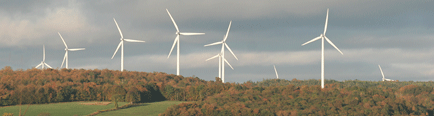
NSTAR To Offer Renewable Energy Option To Customers

NSTAR, the Massachusetts-based electric utility, announced this month that starting in July 2008, its customers will be able to purchase wind power. The program, NSTAR Green, will allow customers to either power 50% or 100% of their homes/businesses with wind power.

According to NSTAR, there will be a slight premium charged to basic home customers who enroll in the program (NSTAR estimates that this will add from $4-$7 per month to a customer’s bill). The wind power will be generated at Maple Ridge Wind Farm in upstate New York, before traveling into the New England power grid.

I’m pleased to see NSTAR announce this program, although I’m surprised it took them so long to do so. I met with a member of their senior management last fall to discuss my firm’s wind power initiatives, and explained that I believed NSTAR customers were hungry for green energy options. However, as the saying goes, better late than never.

Although wind energy from other states has just as positive an impact on the environment, it’s too bad that bureaucratic and political issues have delayed the development of wind farms in Massachusetts. Please see my previous post on the subject.

Nevertheless, NSTAR should be congratulated for getting this program off the ground. My hope is that programs like this will spur further wind farm development across the United States, with the overall goal of weaning our country off oil, most of which comes from foreign sources.


BBJ Article on stagnant clean energy development in Mass

I read an article in today’s edition of the Boston Business Journal discussing the bureaucratic and political challenges facing renewable energy development in Massachusetts.

Much has been written about Cape Wind. However, there are other projects being held up, most notably a large wind farm slated for Brodie Mountain in the Berkshires.

For a state that has such a deep interest in technology and renewable energy, and the intellectual and financial capital to make this region a leader in the burgeoning green economy, the article paints a disappointing picture.

Hopefully, enough positive momentum ($135/barrel oil should help move the projects along) and external pressure will enable the planned developments to move to the next stage – this will not only help us reduce our dependence on oil, most of which comes from foreign sources, but will also create new jobs and spur further investment in our region.

Here’s a link to the full article: “State talks a great green energy game, but leaves production to neighbors.”

A focus on green printing

I work with a wide variety of clients to help them design and execute environmentally-friendly marketing campaigns. A principal component of these programs involves print (direct mail, sales literature, annual reports, etc).

Over the last year, I have tried to distill a lot of what I have read and learned into 5 simple steps to “greening” your print projects:

  1. Use renewable energy, such as wind-generated electricity, in the production process – manufacturing of all kinds, including the creation of collateral, requires large amounts of electricity, traditionally produced by fossil fuel-powered generators. The combustion of fossil fuels creates carbon dioxide and other greenhouse gases that contribute to global warming. Therefore, one of most effective ways to address the environment with your marketing communications is to produce your materials with renewable energy, specifically wind power. Any number of third-party reports highlight that wind power resonates very well with end consumers. Every time you use wind power to print a marketing piece, you are demonstrating a commitment to reducing greenhouse gases. My company, Grossman Marketing Group, prints with 100% certified wind power, which allows our clients to print our “produced with certified wind power” logo on their collateral at no extra cost to their organizations. Not only does this resonate well with end recipients, but it also creates demand for more wind farms, which will help our country reduce our dependence on foreign oil (please see my previous post on this subject: Looking ahead at the promise of wind power).
  2. Choose papers made with a high degree of post-consumer recycled content – this is probably the best way to make your print pieces green, as using post-consumer fiber is significantly less resource intensive than using virgin fibers. Once you make the commitment to use papers with post-consumer content, it is important to translate the environmental benefits to your constituents. The best paper calculator is managed by Environmental Defense, a leading environmental organization. Here’s a link: http://www.edf.org/papercalculator/
  3. Choose papers with FSC-certified fiber to preserve forest lands – the Forest Stewardship Council certifies that papers came from trees that were planted specifically for paper production. Although FSC-certified papers may come from virgin fibers, FSC is a good stamp of approval for a printed piece (although unlike renewable energy, most end consumers do not know what FSC means, and thus it does not generally resonate well)
  4. Choose papers made with process chlorine free (PCF) or elemental chlorine free (ECF) pulps – when paper is bleached with elemental chlorine, there can be harmful byproducts. Therefore, some paper manufacturers, notably Mohawk, have made great strides to reduce the amount of chlorine used in the bleaching process. For more information, please visit the following link on Mohawk’s site: http://www.mohawkpaper.com/environment/water/chlorine-free-pulp/
  5. Use vegetable-based inksSoy inks (or, most accurately “Soy-based inks”) are made almost identically to regular printing inks, with the substitution of vegetable oil (predominately soybean oil) for traditional petroleum-based oil. Ink is composed of approximately 35% oil (varies a bit from ink to ink), so when referring to soy-based inks, that is the approximate percentage you should cite. Therefore, when using vegetable-based inks, you know that you are reducing the demand for petroleum-based products, and using oil products that almost certainly have been refined in the United States. The remaining 65% of ink, whether soy-based or traditional, is made up of waxes and resins (which hold the ink together), dryers (which enable the ink to dry), and pigments (which give ink the color).

Looking ahead at the promise of wind power

I have written frequently on the benefits of renewable energy, specifically wind power. It is easy to build, emission free, and uses less than 5% of the land on which turbines are sited.

As a result, wind power is the fastest-growing energy source in the world. It has taken my industry by storm – we see more and more clients who want their products made in plants powered with wind power (using offsets), as it helps send a values-laden message to an organization’s constituents that they are trying to be good stewards of the environment.

And although this is leading to higher wind power costs, as well as rising prices for the turbine equipment (see article from last week in TreeHugger: article), this is not such a bad thing. As the aforementioned article states, “The fact that demand is so high pushes prices upward, but that will only serve to attract more players; investors will see that there’s money to be made with wind power and large industrial companies might shift more resources to their wind power divisions. In fact, demand has been high for long enough to show the market that wind power is not simply a passing fad.”

All of these developments will lead to greater wind power generation capacity which will help the US reduce its dependence on oil, the majority of which comes from foreign sources. It may take a number of years, but the promise is great – as demonstrated in Spain. During one week this spring, wind power accounted for just over 40% of the country’s overall energy demand. And although this number may be a bit high, due to lower-than-normal energy demand, this figure is very exciting and gives us a big goal to shoot for.

Dell’s HQ Switches to 100 Percent Renewable Energy

In further news that renewable energy is a good thing for an organization to adopt, see the news below about Dell, courtesy of GreenBiz.com

OAKLAND, Calif., April 3, 2008 — Energy from wind and landfill gas sources now completely powers Dell Inc.’s 2.1 million square foot headquarters in Austin, Texas, the computer maker said Wednesday.

Dell’s announcement of a deal with Waste Management and TXU Energy Wind Power is part of its bid to achieve carbon neutrality at its owned and leased facilities this year.

Waste Management’s Austin Community Landfill gas-to-energy facility will supply about 40 percent of the power needs at Dell’s headquarters, with the remainder coming from existing wind farms in the state through TXU Energy.

Dell’s Austin Parmer Campus also is seeing an increase in green power, from 8 percent to 17 percent, through Austin Energy. The company’s Twin Falls, Idaho, facility is also powered completely by wind and solar power.

In a conference call with reporters Wednesday, the company said the contract is for a little more than 80 million kilowatt hours per year. Dell declined to say how much the contract was worth, but predicted that green power, which now sells for a slight premium compared to conventional power, could one day sell more cheaply.

Retrofit projects across Dell facilities, such as deploying power management systems and replacing inefficient lighting and air conditioners, save the company $2 million a year.

The news comes just days after the company said it would close a desktop PC manufacturing plant in Austin and lay off as many as 8,800 workers as part of a massive restructuring plan designed to save the company $3 billion during the next three years.

http://www.greenbiz.com/news/news_third.cfm?NewsID=55840

My firm recognized for its success with environmental communications

In early March 2008, my firm, Grossman Marketing Group, announced that we had delivered more than 100 million envelopes made from certified wind power to our clients for their direct mail programs. Here’s a link to a Somerville, MA blog:

http://www.wickedlocal.com/somerville/archive/x1637678427

http://www.wapa.gov/es/greennews/2008/mar2408.htm

NYTimes article on wind power

The New York Times published an interesting article on the growth of the wind power industry. Definitely a good read for people who are interested in renewable energy.

Please note – photo courtesy of The New York Times (photographer: Brian Harkin).

****

February 23, 2008
The Energy Challenge
Move Over, Oil, There’s Money in Texas Wind
By CLIFFORD KRAUSS

SWEETWATER, Tex. — The wind turbines that recently went up on Louis Brooks’s ranch are twice as high as the Statue of Liberty, with blades that span as wide as the wingspan of a jumbo jet. More important from his point of view, he is paid $500 a month apiece to permit 78 of them on his land, with 76 more on the way.

“That’s just money you’re hearing,” he said as they hummed in a brisk breeze recently.

Texas, once the oil capital of North America, is rapidly turning into the capital of wind power. After breakneck growth the last three years, Texas has reached the point that more than 3 percent of its electricity, enough to supply power to one million homes, comes from wind turbines.

To read the entire article, please visit the following website:
http://www.nytimes.com/2008/02/23/business/23wind.html

The relevance of wind power

Paper manufacturing, envelope conversion and printing require significant quantities of electricity, which is traditionally produced by generators run by fossil fuels: coal, oil or gas. Since the combustion of fossil fuel creates carbon dioxide and other greenhouse gases are contributing to global warming, the urgency of changing to cleaner (emission-free) renewable sources of energy has increased. Renewable and therefore sustainable energy sources available today include wind, solar, hydroelectric, geothermal and ocean tides.


Why Wind?

Wind power is the fastest growing energy source in the world. At present, it is the least expensive, most developed and fastest-to-build alternative to fossil fuel. Because wind turbines (aka windmills) use less than 5% of the land where they are sited, they minimize habitat destruction, help preserve open space and allow for multiple uses of the land.


Power generated by wind turbines is fed into the electric grid and replaces electricity generated by fossil fuel.