Alternative energy: striking a balance between caution and execution

There has been increasing news coverage of alternative energy, most notably due to the explosion in energy prices over the last couple years.  I saw two interesting articles over the last day, one from the conservative editorial pages of The Wall Street Journal, and the other from The New York Times.

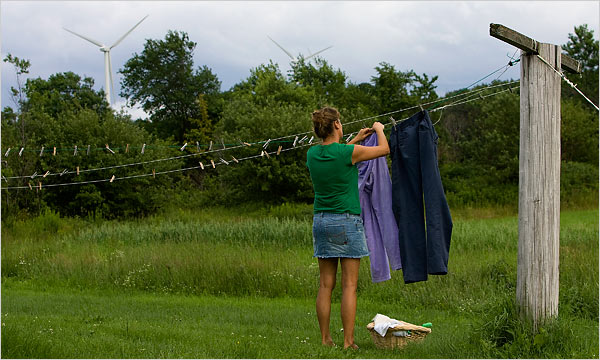
Please note – photo courtesy of The New York Times (photographer: Christinne Muschi).

The WSJ opinion piece points out that one of the key barriers to growth in alternative energy is infrastructure, most notably transmission lines connecting the sources of energy (wind and solar fields in rural and desert locations in the plains and Southwest) and the cities in which most people live.  The WSJ, in it’s characteristic fashion, blames this challenge on liberals, who they claim support alternative energy but oppose the construction of transmission lines, as they often have to go through protected lands.  Here’s a link to the piece.

The Times describes challenges and conflicts of interest that have arisen in upstate New York, where wind revenue has become critical for family farmers.  The article highlights instances when local town boards have voted on wind leases for firms when several of the individual members already had contracts in place for their own farms.  A key issue, the article goes on to discuss, is that there is no statewide (New York) law on wind power, so it is up to the individual towns to decide.  Here’s a link to the article.

If alternative energy is to become more widespread (according to the WSJ, wind only provides two-thirds of 1% of electricity generated in the U.S., and solar one-tenth of 1%), there will have to be better statewide and national legislation that fast tracks the development of wind farms, solar fields, and other energy sources.  At the same time, a balance has to be struck between speed and careful examination of the intricacies of development (impact on local environments, costs, etc).

Nevertheless, it is no longer debatable that these technologies are needed.  In fact, weaning our country off of foreign oil and developing better domestic, renewable (and clean) energy resources are key elements and ingredients to the future success of our country.  My sincere hope is that the right balance can happen in order to unlock this power and bring jobs to local markets with it.
“Texas to Tel Aviv”: Excellent op-ed piece by Tom Friedman in the NYTimes

I had the chance to read Tom Friedman’s most recent op-ed piece, “Texas To Tel Aviv” in the New York Times today, and felt compelled to share it with the folks who read Sustainable Ink.

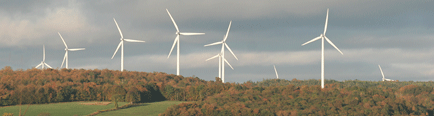
The article focuses on two people: T. Boone Pickens and Shai Agassi.  Pickens, who made his fortune in the oil business, is leading a charge to get the United States to devote a significant amount of resources to the development of wind energy.  In fact, he has spent $2 billion of his own money buying land in the Texas Panhandle as well as 700 wind turbines from GE (their largest turbine order ever), in order to create the largest wind farm in the world.  To read more about his efforts, please visit the Pickens Plan website.

Agassi, an Israeli technology guru, launched Project Better Place last year, with the goal of creating a nationwide grid of electric cars in Israel.  The project has a very ambitious mission, but has been gaining traction with car makers and governments.

The reason I wanted to call your attention to the column, and more importantly to these two entrepreneurs with bold visions, is because electric cars and renewable energy are game-changing initiatives that have the potential to have a dramatic impact on the fight against global warming as well as our nation’s addiction to oil, most of which comes from foreign sources.  Pickens and Agassi are showing that doing well while doing good are not mutually exclusive ideas.

Over the last 16 months, my firm has been at the forefront of bringing renewable energy to the marketing industry.  We not only have powered our own plants with wind energy, but created a cooperative group that comprised a half-dozen other firms in our space to do the same.  As a result, we have saved tens of thousands of gallons of oil as well as eliminated more than 1 million pounds of carbon emissions from the atmosphere.  For these efforts, we have been recognized by the United States Environmental Protection Agency.

Pickens and Agassi are impressive because they are not waiting for the US Congress to act to make renewable energy initiatives easier.  Neither should we.  Each of us in our own way, either personally or organizationally, can do our share to reduce our dependence on oil by moving to renewable energy.  My firm, Grossman Marketing Group, decided that the best way to do this is to use wind power to produce all of our marketing materials.  Our efforts have been endorsed by some of our country’s most reputable environmental organizations, including the League of Conservation Voters and the National Park Foundation.  In addition, many of the nearly 100 clients that have produced their materials with us bearing our proprietary wind power logo have received positive feedback in the marketplace for doing so.

It is incumbent upon us in the marketing industry to do our part to fight global warming and the country’s addiction to oil, and we believe wind power is the best way to make that a reality.

For a link to the full Friedman column, please click here.

NSTAR To Offer Renewable Energy Option To Customers

NSTAR, the Massachusetts-based electric utility, announced this month that starting in July 2008, its customers will be able to purchase wind power. The program, NSTAR Green, will allow customers to either power 50% or 100% of their homes/businesses with wind power.

According to NSTAR, there will be a slight premium charged to basic home customers who enroll in the program (NSTAR estimates that this will add from $4-$7 per month to a customer’s bill). The wind power will be generated at Maple Ridge Wind Farm in upstate New York, before traveling into the New England power grid.

I’m pleased to see NSTAR announce this program, although I’m surprised it took them so long to do so. I met with a member of their senior management last fall to discuss my firm’s wind power initiatives, and explained that I believed NSTAR customers were hungry for green energy options. However, as the saying goes, better late than never.

Although wind energy from other states has just as positive an impact on the environment, it’s too bad that bureaucratic and political issues have delayed the development of wind farms in Massachusetts. Please see my previous post on the subject.

Nevertheless, NSTAR should be congratulated for getting this program off the ground. My hope is that programs like this will spur further wind farm development across the United States, with the overall goal of weaning our country off oil, most of which comes from foreign sources.

BBJ Article on stagnant clean energy development in Mass

I read an article in today’s edition of the Boston Business Journal discussing the bureaucratic and political challenges facing renewable energy development in Massachusetts.

Much has been written about Cape Wind. However, there are other projects being held up, most notably a large wind farm slated for Brodie Mountain in the Berkshires.

For a state that has such a deep interest in technology and renewable energy, and the intellectual and financial capital to make this region a leader in the burgeoning green economy, the article paints a disappointing picture.

Hopefully, enough positive momentum ($135/barrel oil should help move the projects along) and external pressure will enable the planned developments to move to the next stage – this will not only help us reduce our dependence on oil, most of which comes from foreign sources, but will also create new jobs and spur further investment in our region.

Here’s a link to the full article: “State talks a great green energy game, but leaves production to neighbors.”