Newsweek: Green really means business

I had the chance to read an excellent essay in the 9/22/08 issue of Newsweek, by Zachary Karabell of RiverTwice Research, which I strongly recommend.  The main message of the article is that in an era of high energy costs, a company that has sustainable business practices will likely be able to save money and reap positive financial returns as a result.

Karabell writes that “sharply higher prices for oil and raw materials” have made “reductions in energy use economically viable and strategically important in a way that no amount of green activism ever could.”  He continues by discussing Wal-Mart’s efforts to “green” its supply chain: “To maintain its razor-thin margins at a time of record oil prices, which are raising the cost of importing goods from China, Wal-Mart has radically altered how its products are made and how they’re transported. One example: making detergent more concentrated, which leads Wal-Mart suppliers to use smaller plastic containers, which in turn use less petroleum to manufacture those containers, which can then be shipped with more containers in each carton, which leads to less cardboard, which makes it possible to transport more units on each ship or truck, which then reduces the amount of gas used to get those units from the factory to Wal-Mart outlets. The result: Wal-Mart maintains margins and reduces its resource consumption as well as that of its suppliers.”

Karabell also goes on to mention other profit-driven reasons for companies’ sustainability efforts: international regulatory rules as well as studies showing that companies that receive high environmental marks have shown above-average return on investment and stock price performance.

I have frequently written about the importance of green business practices, not only because they are the right thing to do but also because they help the bottom line.
Whatever the reason, the fact that companies like Wal-Mart, Du Pont and Google, to name a few, are all investing heavily in making their businesses less resource intensive, and therefore more profitable, is a great step.  Our national government has not done enough to create incentives for companies and individuals to invest now to save resources and money in the long run, so it is incumbent on the business community to take the initiative.

Relative to my business, Grossman Marketing Group, we strongly urge our clients to not only operate their core businesses responsibly, but also to make the effort to bring that message of sustainability to their constituents through their marketing and communications campaigns.  Whether it’s a piece of direct mail or a giveaway at a tradeshow, by leveraging environmentally-friendly materials, and clearly communicating what they have done to make their pieces less resource-intensive and the savings derived by doing so, they will send a values-laden message to their core customers and donors that will help reinforce their brand and build relationships for the long term.

Here’s a link to the full Newsweek article.

Advertising Age: How to Avoid Eco-Fatigue

I came across an interesting article yesterday in Advertising Age titled “How to Avoid Eco Fatigue.”

The article, written by Jennifer Maxwell-Muir of Maxwell PR, a firm with a wide range of experience in the natural/organic industry, states that consumers are getting tired of the massive news coverage and marketing campaigns surrounding the “green” movement.  Maxwell-Muir provides some helpful tips on how companies can cut through the noise and reach consumers with a green message:

7 Tips to Avoid Eco-Fatigue

  1. Be remarkable. You can make the “greenest” product on the planet, but unless it solves a significant consumer problem, works or tastes better than anything in the market and offers a good value in ratio to price, consumers won’t buy it.
  2. Be green because it’s something you value, not as a marketing gimmick. Can coal really market the industry as being green and clean? What is Kermit the Frog doing with the Ford Escape? People smell falsehoods, and you go from bad to worse.
  3. Don’t be bashful. A lot of truly “green” companies are afraid to speak up because it feels too self-righteous. Consumers actually appreciate your efforts, no matter the size, as long as they’re earnest and a step in the right direction. The amplification of your message can increase with your commitments.
  4. Make it fun and engaging. Green doesn’t have to be staid. The average consumer doesn’t even know that the “hip” home cleaning products (is that an oxymoron?) made by Method are even green. And that’s entirely the point. This fast-growing brand wants consumers to love its product first — because they’re well-designed, smell beautiful and work well. They’re also planet friendly. Method’s attitude is: Why wouldn’t they be?
  5. Partner with an established nonprofit. When Kettle Foods wanted to add a cause element to its new Backyard Barbecue flavor, it immediately thought of wildlife habitat protection because it’s something it does in its own backyard. To inspire consumers to apply the same principles at home, Kettle partnered with a respected nonprofit, the National Wildlife Foundation. Then it encouraged people to get involved by creating their own backyard wildlife habitats. Who wouldn’t want a bag of free chips as thanks for attracting local birds?
  6. Invite consumers to join you. A flushable diaper doesn’t sound like a product that would inspire a cult following, but gDiapers realized early on that its core consumers were a vocal bunch. So gDiaper empowered them. By creating gMums and gDads, the company arms independent, trusted “spokespeople” with free product and the tools they need to spread the word. Doesn’t get much better than that.
  7. Move beyond green. Green is a fad. Sustainability is continual improvement. If you’re only looking at energy consumption, you’re just scratching the tip of the iceberg. Businesses that endorse a “triple-bottom-line” approach — Organic Valley Farms, New Belgium and Clif Bar, to name a few — also address their affect on society in their communities. Environment is the third leg of the stool, but without the other two, you wouldn’t have a place to sit.

Please click here to access the entire article.

Alternative energy: striking a balance between caution and execution

There has been increasing news coverage of alternative energy, most notably due to the explosion in energy prices over the last couple years.  I saw two interesting articles over the last day, one from the conservative editorial pages of The Wall Street Journal, and the other from The New York Times.

Please note – photo courtesy of The New York Times (photographer: Christinne Muschi).

The WSJ opinion piece points out that one of the key barriers to growth in alternative energy is infrastructure, most notably transmission lines connecting the sources of energy (wind and solar fields in rural and desert locations in the plains and Southwest) and the cities in which most people live.  The WSJ, in it’s characteristic fashion, blames this challenge on liberals, who they claim support alternative energy but oppose the construction of transmission lines, as they often have to go through protected lands.  Here’s a link to the piece.

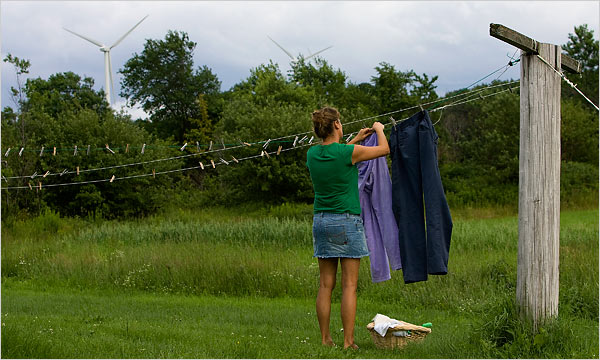
The Times describes challenges and conflicts of interest that have arisen in upstate New York, where wind revenue has become critical for family farmers.  The article highlights instances when local town boards have voted on wind leases for firms when several of the individual members already had contracts in place for their own farms.  A key issue, the article goes on to discuss, is that there is no statewide (New York) law on wind power, so it is up to the individual towns to decide.  Here’s a link to the article.

If alternative energy is to become more widespread (according to the WSJ, wind only provides two-thirds of 1% of electricity generated in the U.S., and solar one-tenth of 1%), there will have to be better statewide and national legislation that fast tracks the development of wind farms, solar fields, and other energy sources.  At the same time, a balance has to be struck between speed and careful examination of the intricacies of development (impact on local environments, costs, etc).

Nevertheless, it is no longer debatable that these technologies are needed.  In fact, weaning our country off of foreign oil and developing better domestic, renewable (and clean) energy resources are key elements and ingredients to the future success of our country.  My sincere hope is that the right balance can happen in order to unlock this power and bring jobs to local markets with it.

Exciting offer for Sustainable Ink readers

Hi all – my last post on Tom Friedman’s op-ed, and the traffic and links from all of you, got noticed by his publisher, Macmillan.

They contacted me yesterday with an offer for readers of Sustainable Ink.  From now until August 11th, they are giving away the audiobook version of his bestseller, The World is Flat, online in anticipation of his new book Hot, Flat, and Crowded: Why We Need a Green Revolution — And How It Can Renew America. You will also receive an exclusive audio excerpt of his new book well before its September publication.

Here’s a link to the offer: http://www.thomaslfriedman.com/giveaway

As someone who’s read The World is Flat, I definitely recommend it, and this is a way to get it for free.

Have a great weekend!

New cause-driven social network, Karma411, could be excellent marketing tool for corporations, development channel for nonprofit organizations

A friend of mine, John Murcott (I went to business school with his wife, Gretchen), recently launched Karma411, with his former partner at FatWire Software, Mark Fasciano.

Karma411 describes itself as a “cause-driven social collaboration site.” The two principal purposes of the site are to serve as a social network for socially-minded people and to allow its members to “start a campaign to raise money and awareness” for their “favorite cause or nonprofit.”

Although Karma411 is in its infancy, I believe marketing professionals at nonprofit organizations and companies should be aware of this site for several reasons:

  1. For nonprofits, the network could be a new channel through which they can raise money. One of the main services of Karma411 is campaign management, and nonprofits can even set up microsites within the network to accept donations
  2. For nonprofits, Karma411 may be a great source of volunteers for their organizations. The site asks its members to highlight some causes/organizations that are important to them. If I were a development director, I would look for members who have stated that they care about my cause, and then would have someone from my organization contact that member. Quite often, people may care about the work that a group does, but have never been asked to get involved, and do not know how to do so. The right email to these people may make a huge difference.
  3. For corporations, Karma411 could be a great marketing tool. Much has been written about how socially-conscious consumers often earn more than the median salary in this country and are willing to pay more for products and services from companies that are seen as good corporate citizens. Members of Karma411 will be a valuable source of potential customers for these types of companies, and once there is a critical mass of members, advertising and promoting through this site could be a cost-effective way to reach this group
  4. For both nonprofits and corporations, Karma411 can be an excellent research tool. The site easily allows a member to create a poll, a function that should help organizations gather important data about potential customers/donors/volunteers, etc.

Some pundits might claim that niche social networking sites cannot compete with behemoths like Facebook and myspace. However, smaller, more targeted sites have started to demonstrate excellent success as well, especially as focused advertising destinations. Here’s an excellent article from the Washington Post about this trend. As a focused site, once Karma411 signs up enough users, it should then be able to attract advertisers, who will want to gain access to this small, but likely higher-than-average spending group.

Regardless of the benefit to advertisers, I’m excited to see Karma411 launch, and as a site focused on helping its members improve the world, I wish it and its founders every success. I recently became a member and encourage others to do the same!

WSJ: Firms Use Earth Day To Show Their Green Side


The Wall Street Journal ran an interesting article around Earth Day last week, stating: “As corporate America gets greener, Earth Day is following the path of Valentine’s Day, Easter and Christmas, and turning into a corporate marketing opportunity. But instead of advertising chocolates or toys, companies are selling themselves and their greenness — and often, the biggest marketers are those with sizable carbon footprints.”

Please click here for a link to the article: http://online.wsj.com/article_email/SB120882594222933291-lMyQjAxMDI4MDI4MjgyMjI1Wj.html The article goes on to discuss various companies showcasing their “green” initiatives, as well as the fact that there was a surge in trademark applications in the United States last year for products or ideas bearing the words” green,” eco”or “clean.”

Although green marketing is important, as it allows organizations to communicate values-laden messages to their constituents, consumers are very smart, and it is critical that these initiatives are not simply words. Rather, they need to be backed up by actions throughout the organizations to reduce their carbon footprints. The winners of the green movement will be the ones that have true commitments to environmentally-sound business practices.

BusinessWeek Online announces Green Business newsletter


As a past subscriber of BusinessWeek, I recently received an email announcing the launch of a monthly newsletter on green business. According to their website, the newsletter, which will be published from Spring 2008 until September 2008, is a “monthly digest of our reporting on how climate change, alternative energy development, and the sustainability movement are affecting business.”

At first glance, it looks like a helpful resource for anyone who is interested in green business issues. This month’s focus is green design. To learn more, please visit the following website:

http://www.businessweek.com/green_business/newsletter/index.html